
Via Pia - The Pious Way


VIA PIA
The Pious Way


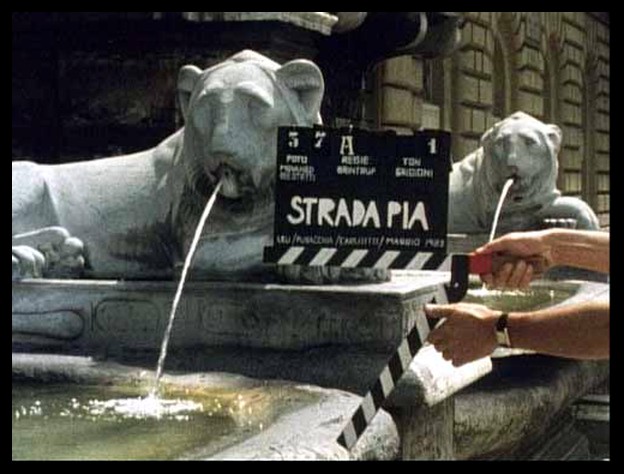 At some point in its two-thousand-year history a pope had christened it Via Pia, the "Pious Way": this ancient street, which the Romans called Via Nomentana, and which still today runs straight for kilometres from the centre over the highest of Rome's seven hills, the Quirinal, and out of the city. A pious street? Can a street be pious? Names mean nothing. They cannot grasp anything, just as one cannot grasp the sound of water. Least of all when they are meant to describe something as ancient, living and indescribable as this Roman street. But names often sound beautiful. And this street has been sounding for two thousand years. What can we learn from its sound?
Rome is full of ancient streets. But what we call "Via Pia" here is more than all the other streets of this city. Besides its important role as a road leading into and out of the city, once to the Forum Romanum and today to the city centre, the Via Pia is a path, namely the path our civilisation has travelled in two thousand years. From no other street in Rome can one look upon so many testimonies, so much architecture from so many different centuries, as from this one: from the huge ancient monuments and walls of the Roman imperial era, through the sparse remains of medieval churches, the elegant palaces of the Renaissance and the triumphant façades of the Baroque, to the bulky buildings and pseudo-architecture of Italy's late-19th-century boom years, and on to the modernist embassies and standard architecture of the sixties and seventies. Buildings in and along one street that describe for us the path from theocracy to democracy, from the rule of a god and his priests to the rule of the people, from unity to freedom.
We can trace this path, which every culture takes, not only through the concentration of buildings from all eras found here, but also through written testimonies. Whether it is the ancients themselves, Frontinus, Martial or Seneca, who described the bustling life on the Quirinal two thousand years ago, or German writers, artists and scholars who were captivated by the attraction of these buildings and inspired by Roman street life. They came, and still come today, to study at one of the German institutes located on the Via Pia or in its immediate vicinity: the Villa Malta, the Villa Massimo (Joachim Blüher, director of the Villa Massimo for German fellows) or the Archaeological Institute.
But the people who live and work in and along the street today also have their say: Walter Maioli, the maker of ancient Roman instruments; Roberto Danieli, composer of the musical about Romulus, the founder of Rome; staff of the Grand Hotel, of the main railway station and so on. In addition, sound pictures try to bring the sound of the street closer: markets, bars, the military bands in front of the Quirinal Palace (the President's residence), at the Porta Pia, on the Via Veneto, film music and excerpts from "La Dolce Vita", street singers, street musicians, sound pictures made of noises and ancient Roman music, and more.
Via Pia is more than just a street in Rome. It consists of many notes that sound together in a chord. On the surface it appears loud and lively like other streets, but in more than two thousand years of history it has acquired a soul that reveals itself to us only slowly. That is part of the fascination this city exerts: one is never finished with it.
| VOICES | Hans Bayer, Gisela Claudius, Thomas Lang, Bodo Primus, Christiane Wedel, Joseph Tratnik, Charly Wagner |
| MUSIC | Antonio Vivaldi, Nino Rota, Carlo Gesualdo, Jacquet de Mantua, Ottorino Respighi, Roberto Danieli, Synaulia, Johannes Brahms, Domenico Modugno, Renzo Rossellini, Franz Schubert, Giuseppe Verdi, Gian Francesco Malipiero, Goffredo Petrassi, Luigi Nono, Franco Donatoni |
| DIRECTOR | Georg Brintrup |
| SOUND ENGINEER | Alexander Hardt |
| EDITOR | Gabriele Faust |
| DURATION | 175 minutes |
| FIRST BROADCAST | 10.04.2004 um 15:00 auf WDR 3 - 3pm |
| REPEAT BROADCAST | 13.08.2005 um 15:00 auf WDR 3 - 3pm |